I'm grateful for how philosophical reflection and action in the world feed into each other, and how the meanings of "American" and "philosophy" merge with other locations and modes of thought.
Marilyn FischerSupporting the study, critique, and appreciation of American philosophy and culture--"American Studies"-- in the tradition of William James, John Dewey, Charles Sanders Peirce, Emerson, Thoreau, et al... This site was constructed initially to support an Independent Readings course at Middle Tennessee State University in the Spring 2021 semester.
Tuesday, August 3, 2021
I Am An American Philosopher: Marilyn Fischer – Society for the Advancement of American Philosophy
Monday, June 7, 2021
WJ's occult-progressive paradox
"Interest" is not un-progressive, uncritical acceptance would be. WJ was interested in why and how others' beliefs (of all sorts) motivated them, and he did believe in believing; but he did not accept all beliefs at face value. https://t.co/RGAKH9yeUW
— Phil Oliver (@OSOPHER) June 7, 2021
Friday, June 4, 2021
Awakening
"...we must remember that the basis of democratic leadership is ordinary citizens’ desire to take their country back from the hands of corrupted plutocratic and imperial elites. This desire is predicated on an awakening among the populace from the seductive lies and comforting illusions that sedate them and a moral channeling of new political energy that constitutes a formidable threat to the status quo. This is what happened in the 1860s, 1890s, 1930s, and 1960s in American history. Just as it looked as if we were about to lose the American democratic experiment—in the face of civil war, imperial greed, economic depression, and racial upheaval—in each of these periods a democratic awakening and activistic energy emerged to keep our democratic project afloat. We must work and hope for such an awakening once again."
"Democracy Matters: Winning the Fight Against Imperialism" by Cornel West: https://a.co/0hthZgT
Friday, May 28, 2021
Inhibition
David Brooks (New York Times, May 28, 2021)
People wear masks when they feel unsafe, and for more than a
year, we were unsafe, and we had to wear masks. But the physical masks we wore
were layered on top of all the
psychological masks we had put on, out of fear, in the years before Covid. Productivity
is a mask. I’m too busy to see you. Essentialism is a mask. I can make all
sorts of assumptions about you based on what racial or ethnic group you are in.
Self-doubt is a mask. I don’t show you
myself because I’m afraid you won’t like me. Distrust is a mask. I wall
myself in because I’m suspicious you’ll hurt me.
As we take off the physical masks, it seems important that we take off the psychological masks as well.
If there is one thing I’ve learned in life, it is that we have more to fear
from our inhibitions than from our vulnerabilities. More lives are wrecked by
the slow and frigid death of emotional closedness than by the short and hot
risks of emotional openness.
William James (The Gospel of Relaxation, 1899)
Well, my friends, if our dear American character is weakened
by all this over-tension,—and I think, whatever reserves you may make, that you
will agree as to the main facts,—where does the remedy lie? It lies, of course,
where lay the origins of the disease. If a vicious fashion and taste are to
blame for the thing, the fashion and taste must be changed. And, though it is
no small thing to inoculate seventy millions of people with new standards, yet,
if there is to be any relief, that will have to be done. We must change ourselves from a race that admires jerk and snap for
their own sakes, and looks down upon low voices and quiet ways as dull, to one
that, on the contrary, has calm for its ideal, and for their own sakes loves
harmony, dignity, and ease.
….
Why do we hear the complaint so often that social life in
New England is either less rich and expressive or more fatiguing than it is in
some other parts of the world? To what is the fact, if fact it be, due unless to the over-active conscience of
the people, afraid of either saying something too trivial and obvious, or
something insincere, or something unworthy of one's interlocutor, or something
in some way or other not adequate to the occasion? How can conversation
possibly steer itself through such a sea of responsibilities and inhibitions as
this? On the other band, conversation does flourish and society is refreshing,
and neither dull on the one band nor exhausting from its effort on the other, wherever people forget their scruples and
take the brakes off their hearts, and let their tongues wag as automatically
and irresponsibly as they will.
Sunday, May 16, 2021
Kaag's 5 best
@JohnKaag's American philosophy #readinglist: https://t.co/u6LqZg6LVJ
(https://twitter.com/five_books/status/1394095347673227264?s=02)
Doesn't hold water
Today was Commencement at Vanderbilt. Just got an email (in appreciation?) from a new graduate.... pic.twitter.com/cAul6mzUBh
— Robert Talisse (@RobertTalisse) May 15, 2021
---Shouldn't a pragmatist find academic debates about what's "essential" (vs. contingent) a distraction from more urgent questions about our practical experience of life and its constituents (H2O among them)? Essential or not, in the philosophers' sense, water is life as we know it.Not if you’re a pragmatist.
— Robert Talisse (@RobertTalisse) May 15, 2021
Not sure this is an argument, until we move beyond "I think you're wrong"... But it is an important difference of perspective on pragmatism and what James called the irrelevancy of many of the "vocables we fire from our conceptual shotguns..." pic.twitter.com/ZpodObbTiH
— Phil Oliver (@OSOPHER) May 16, 2021
Saturday, May 15, 2021
The custom of creativity
Thinking some more, this morning, about creativity and its roots in custom and habit. Younger Daughter just texted me the image of some jewelry she's designed (and sold!), now that she's a college grad she's got time to be creative.
My friend mentioned that my colleague, another of his recent teachers, had instilled in him the habit of journaling. That reminded me of Emerson's seminal question to Thoreau: "Do you keep a journal?"
And that reminded me of Emerson's eulogy for his friend.
Mr. Thoreau was equipped with a most adapted and serviceable body. He was of short stature, firmly built, of light complexion, with strong, serious blue eyes, and a grave aspect,—his face covered in the late years with a becoming beard. His senses were acute, his frame well-knit and hardy, his hands strong and skilful in the use of tools. And there was a wonderful fitness of body and mind. He could pace sixteen rods more accurately than another man could measure them with rod and chain. He could find his path in the woods at night, he said, better by his feet than his eyes. He could estimate the measure of a tree very well by his eye; he could estimate the weight of a calf or a pig, like a dealer. From a box containing a bushel or more of loose pencils, he could take up with his hands fast enough just a dozen pencils at every grasp. He was a good swimmer, runner, skater, boatman, and would probably out-walk most countrymen in a day’s journey. And the relation of body to mind was still finer than we have indicated. He said he wanted every stride his legs made. The length of his walk uniformly made the length of his writing. If shut up in the house, he did not write at all.
I totally get that. The best time to write in your journal is after a walk. Or maybe before. Either way, it needs to be a daily habit.
Friday, May 7, 2021
Wallace Stevens, peripatetic Jamesian
"Wallace Stevens in his forties, living in Hartford, Connecticut, hewed to a productive routine. He rose at six, read for two hours, and walked another hour-three miles-to work. He dictated poems to his secretary. He ate no lunch; at noon he walked for another hour, often to an art gallery. He walked home from work-another hour. After dinner he retired to his study; he went to bed at nine. On Sundays, he walked in the park. I don't know what he did on Saturdays. Perhaps he exchanged a few words with his wife, who posed for the Liberty dime. (One would rather read these people, or lead their lives, than be their wives." Annie Dillard, The Writing Life
Tuesday, May 4, 2021
Quoting James
This is a ‘letter’. This past Sunday was a great family day at Craigicello. Our boys came down to celebrate younger son’s 26th birthday and Mother’s Day. To me, it was more; I called it Neo-Passover, but I’m not sure that will catch on with others. We were having our first meal together as a family inside the house since Christmas of 2019, before the plague began. I think this is a day, different for us all, that we should celebrate as a Passover. We also celebrated by doing some yard work that was a bit too strenuous for the old man.
Waiting for lunch, the delicious poppy-seed chicken dish that is younger son’s favorite, we got to talking about their exam schedule for finals week (both at MTSU). That inspired me to want to read them James’s quote on tests, and flinging the books away. I went to my study and retrieved the (correct) Library of America volume. Before I read from it, they both admired the quality of the book. I showed them the two volumes, and told them they were what you and I referred to when talking James, and used shorthand, like saying ‘p836’.
I said to them, “you know, like the old joke – number 4!” They didn’t know it, so my explanation was that a new prisoner was confused by other prisoners shouting out “number 4” or some other number, and then everybody laughing. It was explained to him that they’d all been in together so long, and knew all the jokes, that they had just numbered them to make it easier.
I told them the p836 story, and how there was an entire concept in a passage on that page that I had related to Egoman. I then read the passage, and we talked about Egoman and the problems he causes us. I went over to page 837, and read the passage about tests, and we had a good discussion about that too.
I realized later that we were having a philosophical discussion without talking ‘Philosophy’. We were talking about experience. That thought took me to James’s quote about defending experience against philosophy.
Me sitting at the table with my sons, reading James from a nice book, reminded me of a deep memory of my grandmother Craig, wife of the more famous and influential Grandfather Craig. She would sit me down before her in that big black rocker chair, now in my living room, and read to me from the bible that was ever-present in her lap, and lecture me. I don’t remember enjoying it. If you recall, my GP2 began with me talking about the interminable lectures I received from this grandfather. It appears that I was getting it from both sides.
And now, here am I, reading from the gospel of Wm. James to my sons before me, his lectures being the foundation of my lectures to my sons. It looks like Craigs are born lecturers. Thank goodness I have found such an abundant source of material.
Saturday, May 1, 2021
"Walpurgisnacht"
Walpurgis Nacht
William James had a very strange experience on this date [July _] in 1898. He called it his Walpurgis Nacht. (Walpurgisnacht is the night before May Day, when spirits are said to walk the earth.)
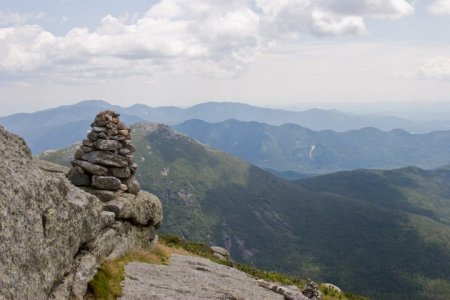
It was a rare “marvelous” mystical moment for James, strange by any account. But stranger still, to me, is the fact that the New York Times recently wrote a story about it and the place where it happened (on Mount Marcy in sight of Mount Haystack and Panther Gorge, in the Adirondacks) called “The Geography of Religious Experience”. It recounts the odd letter James wrote his wife about the episode:
“The moon rose and hung above the scene, leaving a few of the larger stars visible,” he wrote, “and I entered into a state of spiritual alertness of the most vital description. The influences of Nature, the wholesomeness of the people around me… the thought of you and the children … the problem of the Edinburgh lectures [which would become Varieties of Religious Experience], all fermented within me till it became a regular Walpurgis nacht.”
James didn’t have or report many (perhaps any) more mystical experiences of his own, if indeed this counts as one, but he was always willing to credit the testimony of others who did. Or at least, to extend the benefit of the doubt. There’s something very admirable in that, something much finer than a mere credulous “will to make-believe,” in Bertrand Russell’s sneering put-down.
But I wouldn’t call the sort of momentous, amorphous, inexpressible experience he couldn’t find words for but still (like a poet) tried to communicate and point at, a religious experience. It was an experience, thoroughly human and natural (and debilitating, literally heart-rending in this instance). I’ll bet I’d have something like it myself right now, if I went and hiked a mountain. Especially if I’d hiked one the day before yesterday, and the day before that too, as James had. That wouldn’t diminish the exceptionality of it for me, but it ought to make me hesitant to bring supernature into the account. Oughtn’t it?
Mountains and ecstatic philosophizing seemed to go together for James. That’s one thing he had in common with Nietzsche, who admired Emerson’s nature intoxication. You can keep your feet on the ground when your head enters the clouds. U@d 7.7.09
The influences of Nature, the wholesomeness of the people around me…the thought of you [wife Alice] and the children...the problem of the Edinburgh lectures [which would become Varieties of Religious Experience], all fermented within me till it became a regular #Walpurgisnacht.”
— Phil Oliver (@OSOPHER) May 1, 2021
We’re #32
Americans like to boast that "we're No. 1." But a careful new study suggests that in quality of life, we rank No. 32. And we...
-
Dr. Phil Oliver -- phil.oliver@mtsu.edu James Union Building (JUB) 300 Our course explores American philosophy in the context of American cu...
-
Last class already! I'm hitting the road for my annual August meetup with far-flung friends and won't have as much time this week...
-
Oops! Forgot to give you the scorecard Tuesday night. Make a note to record your Jy 9 participation in the "2d inning"column next...