Up@dawn 2.0

Sunday, March 23, 2025

Vicious anti-intellectualism

Looking forward to getting over the virus that sent me to the Vandy walk-in clinic twice in the last four days (and home yesterday with antibiotics). 


And, looking forward to speaking with Agnes Callard Friday afternoon before her Lyceum address about her new book Open Socrates, and her advocacy of a kind of Socratic intellectualism. 


In preparation, I've revisited what William James says about "vicious intellectualism"— it confuses words and concepts for the reality they intend to illuminate.


And, I've  revisited Richard Hofstadter's 1963 classic Anti -intellectualism in American Life. Its message: anti-intellectualism has been the more vicious strain in our national experience. It certainly is now. "Turning answers into questions" may just be the Socratic salvation the times demand.


"As with the pursuit of happiness, the pursuit of truth is itself gratifying whereas consummation often turns out to be elusive. Truth captured loses its glamour; truths long known and widely believed have a way of turning false with time; easy truths are bore and too many of them become half truths. Whatever the intellectual is too certain of, if he is healthily playful, he begins to find unsatisfactory. The meaning of his intellectual life lies not in the possession of truth but in the quest for new uncertainties. Harold Rosenberg summed up this side of the life of the mind supremely well when he said that the intellectual is one who turns answers into questions."


"The citizen cannot cease to need or to be at the mercy of experts, but he can achieve a kind of revenge by ridiculing the wild-eyed professor, the irresponsible brain truster, or the mad scientist, and by applauding the politicians as the pursue the subversive teacher, the suspect scientist, or the allegedly treacherous foreign-policy adviser. There has always been in our national experience a type of mind which elevates hatred to a kind of creed; for this mind, group hatreds take a place in politics similar to the class struggle in some other modern societies. Filled with obscure and ill-directed grievances and frustrations, with elaborate hallucinations about secrets and conspiracies, groups of malcontents have found scapegoats at various times in Masons or abolitionists, Catholics, Mormons, or Jews, Negroes, or immigrants, the liquor interests or the international bankers. In the succession of scapegoats chosen by the followers of this tradition of Know-Nothingism, the intelligentsia have at last in our time found a place."


"Let us admit the case of the conservative," John Dewey once wrote. "If we once start thinking no one can guarantee what will be the outcome, except that many objects, ends and institutions will be surely doomed. Every thinker puts some portion of an apparently stable world in peril, and no one can wholly predict what will emerge in its place." Further, there is no way of guaranteeing that an intellectual class will be discreet and restrained in the use of its influence; the only assurance that can be given to any community is that it will be far worse off if it denies the free uses of the power of intellect than if it permits them. To be sure, intellectuals, contrary to the fantasies of cultural vigilantes, are hardly ever subversive of a society as a whole. But intellect is always on the move against something: some oppression, fraud, illusion, dogma, or interest is constantly falling under the scrutiny of the intellectual class and becoming the object of exposure, indignation, or ridicule.

Saturday, March 15, 2025

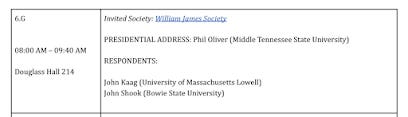
2025 William James Society Presidential Address

Listen on Substack... 

Invited session, Society for the Advancement of American Philosophy annual meeting Washington DC, Howard University - March 15, 2025. 8 a.m. Scheduled respondents John Shook, John Kaag


Good morning. Thank you for rousing yourselves so early for this event. It’s no great sacrifice for me, long a habitue’ of the pre-dawn. Ignore the clock and embrace the hour, I say with Thoreau, “morning is when I am awake and there is a dawn in me… To be awake is to be alive.” Etc.

I do recognize the temperamental element involved in the varieties of auroral experience. If you’re not a morning person, your presence here is all the more gratifying. And if you flew to DC it may even be heroic, these days. Just being here at all is frankly a bit unsettling, tasked as we are with trying to cast a little Jamesian light in the shadow of so benighted a national presidency (albeit one that makes all before it, less one, shine brighter in retrospect).

But since we are here, we should rise to appreciate what Adam Gopnik has lately called our “truly unique, only-once-in-the-universe gift of consciousness. That’s some comfort [my emphasis]. We’ll sleep long enough soon enough.” Being “woke” is not in vogue with the current DC in-crowd, but we interlopers recognize the deep appeal of eyes wide open before eternal dormancy resumes. I like Jane Fonda’s definition: being woke just means “giving a damn.”

The unfortunate timeliness of my title this morning, its allusion to these “dark times,” may need no extensive elaboration. Many of us felt the civic darkness descending well before November’s election, but I don’t think so many of us anticipated, then, the full depth and suddenness of its descent. Those of us who’ve spent decades deliberating (strolling, conversing) with William James, though, know the threat of personal darkness to be perennial for all but the “once-born”... (continues)

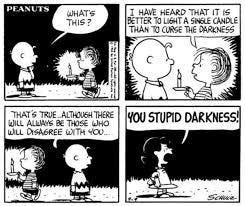
Lighting candles AND cursing darkness

[Accompanying slideshow…]

==

William James Society website/newsletter https://wjsociety.org/news/

Spring 2025 Newsletter WJS President Phil Oliver, Meliorist

President’s Message: Dr. Phil Oliver, WJS Presidential Address at the 2025 Annual Meeting of the Society for the Advancement of American Philosophy

Good morning. Thank you for rousing yourselves so early for this event. It’s no great sacrifice for me, long a habitue’ of the pre-dawn. Ignore the clock and embrace the hour, I say with Thoreau, “morning is when I am awake and there is a dawn in me… To be awake is to be alive.” Etc.

I do recognize the temperamental element involved in the varieties of auroral experience. If you’re not a morning person, your presence here is all the more gratifying. And if you flew to DC it may even be heroic, these days. Just being here at all is frankly a bit unsettling, tasked as we are with trying to cast a little Jamesian light in the shadow of so benighted a national presidency (albeit one that makes all before it, less one, shine brighter in retrospect).

But since we are here, we should rise to appreciate what Adam Gopnik has lately called our “truly unique, only-once-in-the-universe gift of consciousness. That’s some comfort. We’ll sleep long enough soon enough.” Being “woke” is not in vogue with the current DC in-crowd, but we interlopers recognize the deep appeal of eyes wide open before eternal dormancy resumes. I like Jane Fonda’s definition: being woke just means “giving a damn.”

The unfortunate timeliness of my title this morning, its allusion to these “dark times,” may need no extensive elaboration. Many of us felt the civic darkness descending well before November’s election, but I don’t think so many of us anticipated, then, the full depth and suddenness of its descent. Those of us who’ve spent decades deliberating (strolling, conversing) with William James, though, know the threat of personal darkness to be perennial for all but the “once-born”… (continues)


Friday, March 14, 2025

WJS in DC

Frederick Douglass Hall, Howard University-this year's host for the annual meeting of the Society for the Advancement of American Philosophy, site of the William James Societies's presidential address Saturday morning: "Finding Delight in Dark Times: Jamesian Meliorism Now"

Wednesday, March 12, 2025

Berlin seminar (via Zoom) on John Lachs’s Stoic Pragmatism

To organizer Krzysztof Skowronski-

It's looking like a hectic day ahead, preparing for my trip to DC; in case I'm unable to join you, I just want to thank you again for the invitation to participate … and to say that my favorite chapter in John's Stoic Pragmatism is the epilogue. It's so full of his personal wit and wisdom, for instance:

"Believing in what our fervent hopes promise has, in any case, never much appealed to me. I think, on the contrary, that the dignity due our intelligence requires seeing the world and our prospects in it with unclouded eyes. Religion gets undue support from our desire to escape the pain of loss and the dread of death. Although they do not bring out the best in religion, I have no quarrel with such consolations. But philosophers should not need them. They ought to have the courage to look into the abyss alone and to face sudden tragedy and inevitable decline with equanimity born of joy or at least of understanding. I am prepared to be surprised to learn that we have a supernatural destiny, just as I am prepared to be surprised at seeing my neighbor win the lottery. But I don't consider buying tickets an investment."

And:

"As a profession in this country, we have reached a level of irrelevance that renders commercial presses reluctant to publish our work. The in-groupish abstraction of philosophy books makes them the butt of jokes. Yet the public is hungry for thoughtful commentaries on the affairs of life and for guidance on how to deal with its problems. The response to In Love with Life showed me the magnitude of the need people experience for philosophical reflections on what they do and what befalls them. Meeting this need is a project of the greatest importance for philosophers."

And:

"I am unable to think of anything more important for the future of academic philosophy in this country than for it to become less academic."

And:

"I have an intense loyalty to people near to me, which shows itself in my readiness to go to great lengths to promote their good. This attitude defines my relation to friends, students, and family. I also believe that although some things matter intensely, many of the things that upset people are of little significance. This conviction has enabled me to live without condemning much and without the desire to run other people's lives."

And:

"The consideration that in the end we die has disturbed my enjoyment of life just as little as the fate of the food I eat interferes with the delight of a good meal. Focusing on the destination makes us forget the pleasures of the road. Should the eventual extinction of the sun send cold shivers down our backs? Surely not; such issues simply do not matter. Untold generations will have basked in the light before the dark descends. Their joy redeems eventual disaster, or at least proves it irrelevant."

And:
"Few things are more difficult for our burdened and busy generation than focus and absorption. These are the gifts of immediacy, which is not some unconceptualized given but simply the present in whose movement we can feel at home. Momentary forgetfulness can liberate us from the future and the past and reveal the exhilarating beauty of whatever comes our way. This is transcendence—probably the only sort available to animals."

And finally:

"In the end, I do not want to be absorbed in the technical details of the problems of philosophy. My passion is to deploy philosophy to deal with the important issues that face us as individuals, as a nation, and as members of the human race. There is a large public waiting anxiously for what philosophy can offer—for careful thinking, clear vision, and the intelligent examination of our values. That is where the future of philosophy lies, that is where American philosophy has always pointed us, and that is where I will continue to be."

Have a good seminar, Chris, if I don't see you this afternoon.

Best,
Phil


Phil.Oliver@mtsu.edu
👣Solvitur ambulando
💭Sapere aude

Friday, March 7, 2025

"Delightful pessimism"

He found delight in earthquakes too.

"Perry recalled William bringing home a volume of Schopenhauer and reading “amusing specimens of his delightful pessimism.” It is perfectly characteristic of the volatile William James that he later came to loathe Schopenhauer’s pessimism, which he took as equivalent to determinism, and that he came rather delightedly to abuse the author of The World as Will and Idea. Schopenhauer’s pessimism, James wrote twenty-five years later, is “that of a dog who would rather see the world ten times worse than it is, than lose his chance of barking at it.”

"William James: In the Maelstrom of American Modernism" by Robert D. Richardson : https://a.co/6NdhLig

Tuesday, March 4, 2025

Three Roads Back

Richardson's posthumous survey of how hdt, rwe, and WJ rebounded from the worst darkness humans can know is another afterthought for my address that probably should've been in the foreground. Better late than never. Footnotes are a good backstop.

"In dark times, from the personal to the global, one way I have found to fight back against what is going wrong is to re-examine the lives and works of figures from the past. I have spent many decades with Ralph Waldo Emerson, Henry David Thoreau, and William James. All faced disaster, loss, and defeat, and their examples of resilience count among their lasting contributions to modern life.

Emerson taught his readers self-reliance, which he understood to mean self-trust, not self-sufficiency. Thoreau taught his readers to look to Nature—to the green world—rather than to political party, country, family, or religion for guidance on how to live.

William James taught us to look to actual human experience, case by case, rather than to dogma or theory, and showed us how truth is not an abstract or absolute quality, but a process. Experience—testing—either validates or invalidates our assumptions. Further, James says, attention and belief are the same thing. What you give your attention to is the key to what you believe. Whoever or whatever commands your attention also controls what you believe…"

— Three Roads Back: How Emerson, Thoreau, and William James Responded to the Greatest Losses of Their Lives by Robert D. Richardson
https://a.co/5dphVYG

Monday, March 3, 2025

The delight drug

Less than two weeks 'til my James Society Prez Address in DC, where I'm supposed to find "delight in dark times"-a topic more daunting now than I could have imagined back in September when I proposed it. Looking for one last ray to lead us from the cave, I turn again to the always-reliably-illuminating Bob Richardson.

WJ famously decried the inadequacy of words to capture the brilliant immediacy of experience. But it's finally his fluently original way with them that consistently delivers delight. The gaslighting authoritarian apologists and bullies who've presently hijacked our institutions can't take that away. Kipling was right, words are our most powerful drug. Better even than nitrous.

"He was the first to use “hegelism,” “time-line,” and “pluralism.” He had a gift for phrases that stick in the mind: “the bitch-goddess success,” “stream of consciousness,” “one great blooming, buzzing confusion,” “the moral equivalent of war,” “healthy-minded,” and “live option.” He used examples, anecdotes, jokes, anything to impart narrative dash and energy to the page. And there are many places where, standing on the arid plain of experimental data, James turns to face the reader, reaching outward through his own experience to us, in prose that can stand comparison to anyone’s."

--"William James: In the Maelstrom of American Modernism" by Robert D. Richardson: https://a.co/gVAcr6V

Monday, February 17, 2025

A happy and virtuous consciousness

Yesterday was Henry Adams's birthday.*

Late in William James's life-very late-he and Adams corresponded about Adams's entropic pessimism. 

William's attitude is key to finding delight in dark times. It's never too late to be happy.

From the summer of 1910:
…The "second law" is wholly irrelevant to "history"—save that it sets a terminus—for history is the course of things before that terminus, and all that the second law says is that, whatever the history, it must invest itself between that initial maximum and that terminal minimum of difference in energy-level. As the great irrigation-reservoir empties itself, the whole question for us is that of the distribution of its effects, of which rills to guide it into; and the size of the rills has nothing to do with their significance. Human cerebration is the most important rill we know of, and both the "capacity" and the "intensity" factor thereof may be treated as infinitesimal. Yet the filling of such rills would be cheaply bought by the waste of whole sums spent in getting a little of the down-flowing torrent to enter them. Just so of human institutions—their value has in strict theory nothing whatever to do with their energy-budget—being wholly a question of the form the energy flows through. Though the ultimate state of the universe may be its vital and psychical extinction, there is nothing in physics to interfere with the hypothesis that the penultimate state might be the millennium—in other words a state in which a minimum of difference of energy-level might have its exchanges so skillfully canalisĂ©s that a maximum of happy and virtuous consciousness would be the only result. In short, the last expiring pulsation of the universe's life might be, "I am so happy and perfect that I can stand it no longer." You don't believe this and I don't say I do. But I can find nothing in "Energetik" to conflict with its possibility. You seem to me not to discriminate, but to treat quantity and distribution of energy as if they formed one question.
There! that's pretty good for a brain after 18 Nauheim baths—so I won't write another line, nor ask you to reply to me. In case you can't help doing so, however, I will gratify you now by saying that I probably won't jaw back.—It was pleasant at Paris to hear your identically unchanged and "undegraded" voice after so many years of loss of solar energy. Yours ever truly,
WM. JAMES.
[Post-card]

* https://open.substack.com/pub/thewritersalmanac/p/the-writers-almanac-from-sunday-february-95e?r=35ogp&utm_medium=ios (Richard Ford too. Frank Bascombe deals with the second law better than Henry did.)

Monday, February 3, 2025

I Am An American Philosopher: Mariana Alessandri

“It means for my thoughts to grow in this soil—the soil of South Texas for the past 15 years, and in Mexico City whenever I get the chance to think there… To be an American philosopher is to be keenly aware of one’s location in America, to be devoted to a local community, and to agree to think from that place.”

MARIANA ALESSANDRI is Associate Professor of Philosophy, Director of Religious Studies, and Faculty Affiliate in both Mexican-American Studies and Women’s and Gender Studies at the University of Texas-Rio Grande Valley. She is the author of Night Vision: Seeing Ourselves through Dark Moods (Princeton University Press, 2023) which was named an NPR “Book We Love” for 2023. In addition to her other research (spanning existentialism, Latin-American philosophy, and religious studies), and pieces written for popular audiences, she has also been a Fulbright Scholar, been awarded the APA’s prize for public philosophy, and won SAAP’s Jane Addams and Inter-American Philosophy awards. You can find Mariana’s work at www.marianaalessandri.com and on IG @mariana.alessandri

What does American philosophy mean to you?

I used to think American philosophy meant American pragmatism, specifically. Although I enjoy reading William James and Henry David Thoreau, and my pragmatist husband and I even named one of our children after Ralph Waldo Emerson, I do not consider myself an American pragmatist. But American philosopher, yes. It means for my thoughts to grow in this soil—the soil of South Texas for the past 15 years, and in Mexico City whenever I get the chance to think there. I teach at Gloria AnzaldĂșa’s alma mater and have written articles about how I read her as a US-American, Mexican American, and Mexican philosopher. To be an American philosopher is to be keenly aware of one’s location in America, to be devoted to a local community, and to agree to think from that place... (continues)


https://american-philosophy.org/i-am-an-american-philosopher-mariana-alessandri/

Monday, January 6, 2025

WJ's correspondence "arrestingly profound": Emma Sutton

"...My favorite work in American philosophy is the twelve-volume collection of The Correspondence of William James. For me his landmark publications, The Principles of Psychology, The Varieties of Religious Experience, and Pragmatism etc., are like the studio photographs of his era; they preserve one moment in his thinking, carefully staged and curated for public viewing; but his letters are more akin to home movies, less polished and professional but also more revealing. Owing to their frequency and intimacy, they capture James’s philosophy in motion and, crucially, in context; the juxtapositions of his comments and ideas are frequently gossipy, humorous, and mundane but at the same time arrestingly profound.

In place of recommended reading, I’d like to propose some recommended viewing! I recently watched this video of a talk by James scholar Ariel Dempsey. She’s a medic and dancer who is currently carrying out research for her PhD on James’s ideas about living with uncertainty, with the aim of enriching medical approaches to end-of-life care. (Her focus on the difficulties of coping with uncertainty also, I’d suggest, has practical applications within the field of mental health more generally.)

She performs some of her own choreography as part of her presentation, and this type of embodied philosophical enactment is appealing on many levels, not least its valuable public engagement potential. In his essay on the “The Gospel of Relaxation,” James himself began unpacking the links between emotion, body and gesture, and his embedding of emotion and feeling into the project of philosophy is well known. It seems to me that there is much to be gained, in practice and pedagogy, from moving beyond text and brain-based conceptions of philosophy and into a realm of whole-body thinking." 

--Emma Sutton

Think for yourselves, American scholars (but not BY yourselves)

On this day in 1837, Ralph Waldo Emerson delivered his famous “American Scholar” address to the Phi Beta Kappa Society at Harvard . He tol...